
What Are Mutuals?
Mutual insurance has a long history in the United States and around the world and represents a large and important segment of the insurance industry. This segment is one that has the purpose of providing value and protection to its policyholders. Mutuals don’t answer to shareholders - as other kinds of insurance companies do - because they don’t have shareholders. For mutuals, the policyholders/members have distinct governance and other control rights in the company. It is not a coincidence that more than half of the mutual insurance companies operating today are more than 100 years old, with the median age of 120. Below is a brief history of the mutual insurance industry.
The Mutual Industry’s Influence
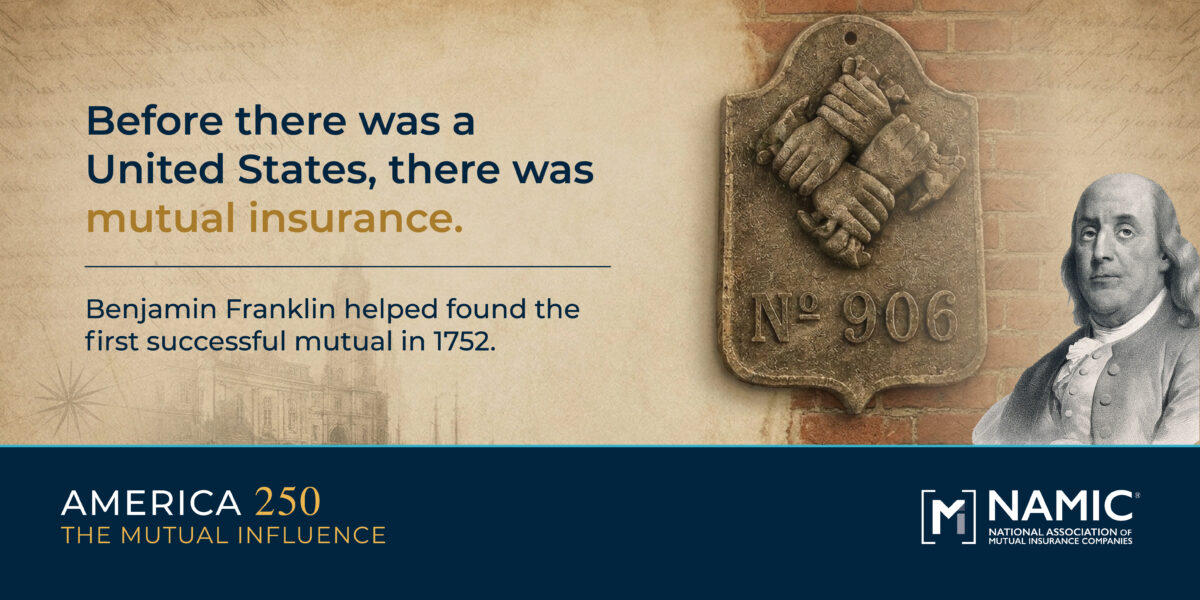
1752
1752
 THE CONTRIBUTIONSHIP BECOMES A COMPANY
Benjamin Franklin and fellow firefighters create what becomes the first successful American mutual insurance company.
1776
1776
A NATION FORMS
The Founding Fathers unanimously adopt the Declaration of Independence on July 4, 1776.
1784
1784
COMPETITION COMES TO MUTUAL INSURANCE
The Contributionship gains competition when a group of its policyholders splits with the company to create a company nicknamed “Green Tree.”
1790s
1790s
THE MUTUAL MODEL EXPANDS
Mutual insurers form in Virginia and New York, showing the ability for regional scalability.
1835
1835
FACTORY MUTUALS EMERGE
Factory mutuals link coverage to strict safety standards, helping transform industrial risk management.
1840s–1850s
1840s–1850s
FARM AND TOWN MUTUALS EXPAND WESTWARD
Rural community-based insurance allows agricultural growth across the Midwest and Great Plains.
1862
1862
THE HOMESTEAD ACT OF 1862 GAVE 160 ACRES OF WESTERN FARMLAND TO ANY CITIZEN WILLING TO CLAIM IT.
Homesteaders settling in the new farmland did not trust business and financial entities on the northeastern coast. This sentiment led farmers to create their own social and political organizations, often called "Granges."
The Grange in each state lobbied for laws allowing formation of farm mutual fire insurance companies, and it often served as an organizational foundation for the state’s first farm mutual insurers.
1870s - 1900s
1870s - 1900s
THE FARM MUTUAL MOVEMENT, DURING WHICH APPROXIMATELY 1,100 COUNTY FARM MUTUAL INSURANCE COMPANIES WERE FORMED, OCCURRED BETWEEN 1870 AND 1900.
The number of farm mutual companies grew through the first half of the 1920s, peaking near 2,000 in 1925.
In the next several decades as farms became larger and the number of farmers decreased, these companies consolidated and began to offer new insurance products. This consolidation of companies and expansion of business lines gave us many of the mutual companies whose names we recognize today.
1895
1895
NAMIC BECOMES AN ASSOCIATION
Mutual insurers form a national association to advocate for and help educate policyholder-owned companies.

1911
1911
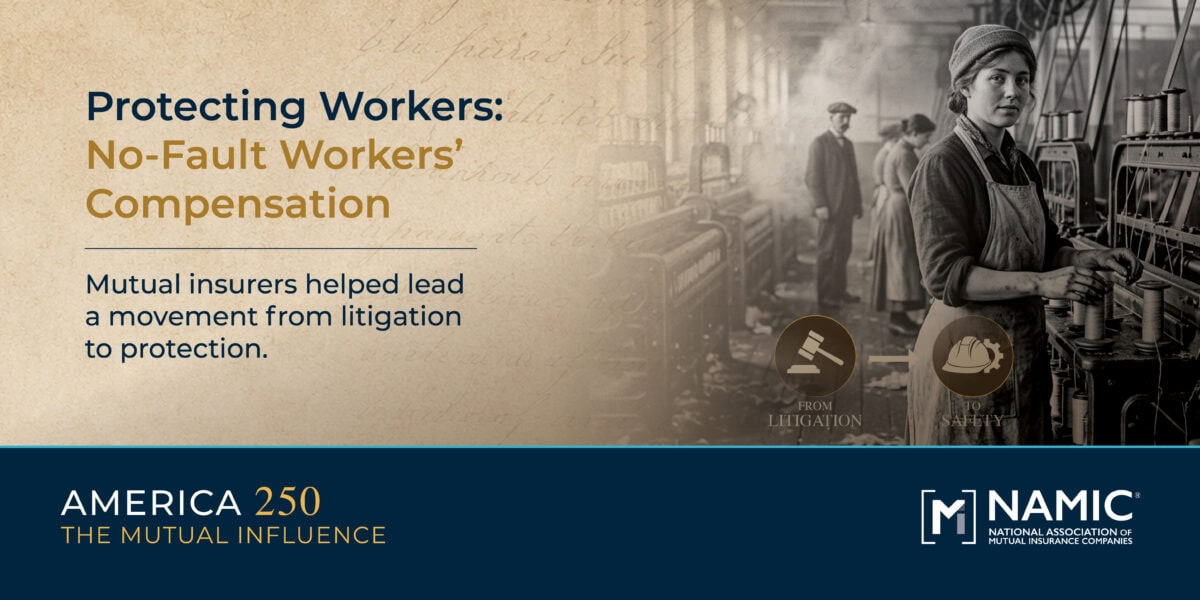
FIRST WORKERS’ COMPENSATION LAWS ENACTED
Wisconsin adopts the first workers’ compensation laws. Mutuals played a leading role in shifting focus from litigation to workplace safety and fair compensation.
1922
1922
WIDESPREAD AUTO OWNERSHIP BECOMES POSSIBLE
Mutual insurers help make automobile ownership affordable for everyday Americans.

1929
1929
THE STOCK MARKET CRASHES
The catastrophic stock market crash ends the 1920s boom, sending the nation into a depression.
1930s
1930s
AMERICA ENDURES THE GREAT DEPRESSION
Mutuals prioritize solvency and policyholders during economic collapse.
1945
1945
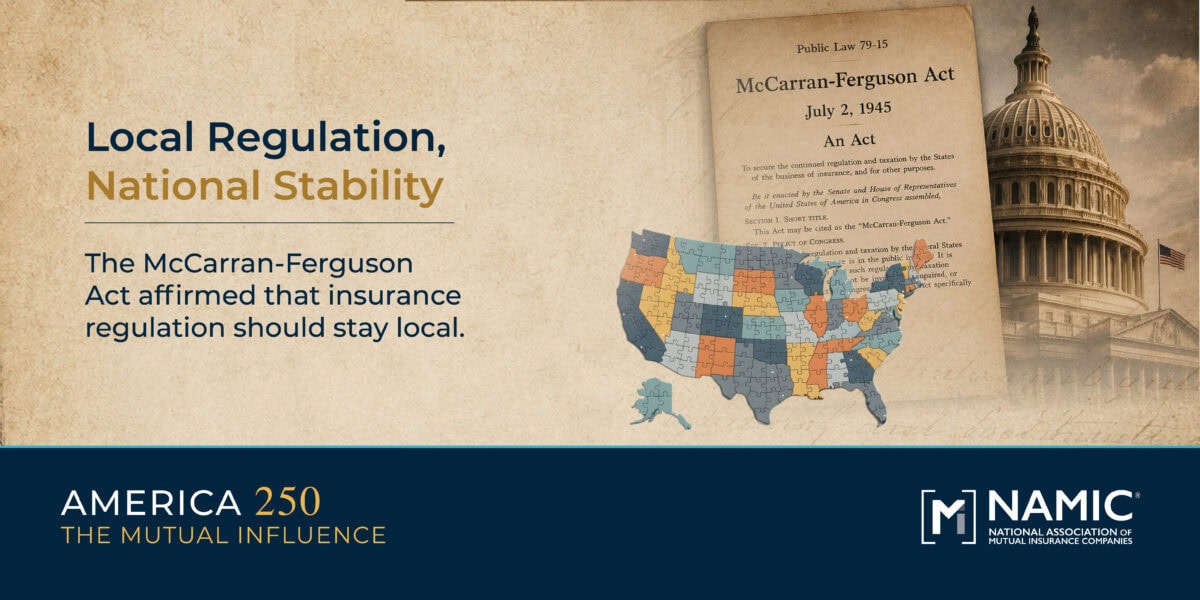
CONGRESS PASSES MCCARRAN-FERGUSON ACT
State-based insurance regulation is preserved when Congress passes the McCarran-Ferguson Act.

1971
1971
ISO FORMS
Small mutuals gain access to shared data and standardized forms.
1985
1985
NAMIC’s Congressional Contact Program begins, giving mutual insurers better opportunities to speak with legislators about the issues impacting the industry.
2002
2002
The Terrorism Risk Insurance Act passes, helping stabilize the economy after the uncertainty following the 9/11 terrorist attacks.
2000s–2010s
2000s–2010s
REPAIR TO PREVENTION
Mutual insurers invest in mitigation, building codes, wildfire and wind research, and loss prevention.
2010
2010
The mutual-industry-backed Insurance Institute for Business and Home Safety opens its research center. The state-of-the-art facility helps inform the industry on property-damage-prevention methods.
2026
2026
TECHNOLOGY MEETS MUTUALITY
Artificial intelligence, IoT, and data analytics help mutuals prevent losses while staying focused on policyholders.
- In 1752, Benjamin Franklin and colleagues founded The Philadelphia Contributionship for the Insurance of Houses from Loss by Fire. It is still in business today.
- The Homestead Act of 1862 gave 160 acres of western farmland to any citizen willing to claim it. Homesteaders settling in the new farmland did not trust business and financial entities on the northeastern coast. This sentiment led farmers to create their own social and political organizations, often called “Granges.” The Grange in each state lobbied for laws allowing formation of farm mutual fire insurance companies, and it often served as an organizational foundation for the state’s first farm mutual insurers.
- The farm mutual movement, during which approximately 1,100 county farm mutual insurance companies were formed, occurred between 1870 and 1900. The number of farm mutual companies grew through the first half of the 1920s, peaking near 2,000 in 1925.
- In the next several decades as farms became larger and the number of farmers decreased, these companies consolidated and began to offer new insurance products. This consolidation of companies and expansion of business lines gave us many of the mutual companies whose names we recognize today.
- Throughout their history, mutual companies have provided a stable economic platform because they are not subject to meeting quarterly stock performance metrics. The mutual model provides a structure that has proven durable and compatible with the long-term nature of insurance needs. It is not a coincidence that more than half of the mutual insurance companies operating today are more than 100 years old, with the median age of 120.
Share the Story of Mutual Insurance’s 250-Year Impact on America
For more than 250 years, mutual insurance companies have helped protect American families, businesses, farms, and communities through moments of challenge, growth, and transformation. From Benjamin Franklin’s first mutual insurance company in 1752 to today’s innovations in risk prevention and resilience, the mutual insurance industry has played a vital role in shaping and strengthening the nation.
To celebrate America’s semiquincentennial, NAMIC has created a collection of ready-to-share social media graphics and sample posts highlighting key moments in mutual insurance history and the enduring value of mutuality.
We invite NAMIC members, partners, and industry professionals to help tell this story. Download the assets, share them across your social channels, and join us in showcasing the legacy—and future—of mutual insurance in America.
How to Use the Toolkit
Encourage your employees, agents, and partners to participate and share. Together, we can celebrate the mutual insurance industry’s role in protecting the American dream for more than 250 years—and the generations still to come.
- Download the social media graphics and sample copy below.
- Customize the messaging for your organization or audience if desired.
- Share the content on LinkedIn, Facebook, Instagram, X, or other social platforms.
- Tag NAMIC when posting to help amplify the message.
Social Graphics